Monday, May 6, 2019

Mothers Out Front and the Response to the the New York Time's Food & Climate Article

Mothers Out Front had a planning meeting last night to discuss, among other things, SF's Climate Emergency Resolution, Movie Night with "Paris to Pittsburgh," the Mayor's Earth Day press conference, Transit, Revolution Foods, and the Mother's Day postcards you see here, urging Congress members Feinstein and Pelosi to co-sponsor the Green New Deal "to give our children the gift of a livable climate." The Food Section of the NYTimes, May 1, a 12-page spread on how our diet affects our planet, is being shown here by Liliana, who hosted our group and served delicious, planet-friendly snacks.

This is what I posted on Facebook, but the group picture I have is of Mothers looking away from Liliana and the New York Times. I didn't think that reflected well on the group!

Friday, April 26, 2019

A Thank You Letter to Leah Garchik for Her Column on "Official Secrets" and Katharine Gun

Dear Leah,

Thank you for your write-up of the screening of "Official Secrets."  Until I read about this today, I knew nothing about Katharine Gun, but like so many thousands of the rest of us, I knew the planned "shock and awe" attack on Iraq was a war crime, and again like thousands, I protested in an attempt to stop the planned attack and invasion.  The media deserve credit for letting us know the truth, and that goes for the SF Chronicle too.  (I still have some of the articles from that time.)

I met Daniel Ellsberg at the Castro Theater in February of 2003, where he was speaking along with Joan Baez in an evening with Reno, Rebel without a Pause .  You may have been there, but if not, there's a DVD of her performance piece.  I wonder whether anyone made a video of that night, when Joan Baez sang the song "This Is My Song," which the Indigo Girls also sing.  You can get both on YouTube.

At the time that Collin Powell had the task of justifying the war on Iraq at the United Nations, I read that officials covered the tapestry version of  Guernica, showing the horrors of war, and of course we all read AT THE TIME , that a big hunk of the "fine" British intelligence was plagiarized from a  paper written by a student at the Monterey Institute, Al-Marashi--even his misspelled words and incorrect punctuation.  (He said later that if they'd let him know they were going to use his paper, he could have given them more up-to-date information.)

I wish the information that Katharine Gun and others provided before the US and England marched forth to Iraq had stopped them from waging war, but they were determined to target Iraq.  It's hard to believe that it was Gun who was in danger of losing her job rather than Bush, Cheney, and Rumsfeld.  Bush got re-elected!

Thanks again,
Tina

Sunday, April 21, 2019

More from the Department of Modern Languages and Literature, SFSU


In addition to the arpilleras shown here, there was a display put out by Nahid Aria ,  Public Relations & Diversit Coordinatore at the office of district attorney Nancy E. o'Malley in Oakland.  This included paintings she has done like the one we're posing near in the picture below.


Also as part of the program, there were talks by Dr. Mohammad Salama of the Arabic Program, Lubna Safi of UC Berkeley, Dr. Olivia Albiero, of the German Program, Dr. Mitra Aria of the Persian Program, Tu Minh of the SF Asian Women's Shelter,


Arpilleras: Crafts by Refugee Women and Other Approaches to Helping

On Friday, April 19th  Shehla and I attended "Arpilleras: Crafts by Refugee Women," a very informative seminar/colloquium/exhibit organized by Ana Luengo and her Spanish 831 graduate students at SFSU. 

Ana gave the overview of Friday's program, which culminated in a talk by Barbara Torres Baquedano, who obtained her MA in Cultural Studies at the University of Bremen with the thesis "There is no tomorrow without yesterday, " an analysis of collective memory in the text of the Valech Report, a report on political prison and torture in Chile between 1973-1990.

For the past 4 years, Barbara Torres Baquedano has worked with refugee women in Bremen, helping them express themselves through a Latin American art form, Arpilleras, shown here:


The arpilleras (burlap pictures)  created by individuals (rather than the communal ones)  give the name and native country of the refugee as well as the path they took.  For example in the one above, Amira says her journey to Bremen  was Somalia-Ethiopia-Sudan-Libya-Malta-Germany.  

They also explain the message, "What I want to say with my picture."  In the case of Amira, she wrote "At the bottom of my painting you can see a table set.  In the foreground I have sewn a plate with food.  When I sewed and embroidered my burlap, I was thinking that I would like to train as a cook, but during the course of this workshop I realized that maybe I am more interested in helping people.  Since I speak many languages,  I would like to learn German and then become a social worker or salesperson."

I was particularly interested in this workshop for at least three reasons.  I know Ana Luengo and am always impressed by the projects she takes on; I'm concerned about refugee women, and I am interested in Bremen , Gemany, because a friend I've had since 1963 (when we were penpals on two sides of the ocean) lives in Bremen.  It seemed a surprising place to have a Latin American art form used to help refugee women from Syria, countries in Africa, and other places.  .  

Continued on another blog post


Thursday, March 14, 2019

Journals of Peace by Katy Hansen in WorldView Magazine 1988

I really want this to be online, so until I find another way to get it on, here it is in my Vistas blog:


RPCVs Pay Tribute
 To President Kennedy
And   His Peace Corps Legacy


World View Magazine:  "RPCVs Pay Tribute to President Kennedy and His Peace Corps Legacy" by Katy Hansen

Tina Martin poured out her heart into 28 journals and diaries during her years in Peace Corps.  Wherever she ventured in Tonga, she carried a note-book and pencil in her basket.

"I've never before shared a word of my diary with anyone," she says.
                                                                                                        
But now she has.  Martin retrieved her treasured journals and briefly shared their private contents with the world.  Martin was among some 400 returned Peace Corps volunteers who gathering in the U.S. Capitol Rotunda November 21-22 to read from their Peace Corps diaries, journals and letters home.  They gave personal testimony to the indelible moments that crystallize their Peace Corps experience years afterwards.
                                                                                                        
The occasion was "Journals of Peace"--a 24-hour vigil of readings organized by the National Council o Returned Peace Corps Volunteers.  The unique event was former volunteers' special way of commemorating the legacy of President John F. Kennedy on the 2tth anniversary of his assassination.

Not all journal readings dealt with Kennedy. The Journals of Peace vigil also became a gift from ex-volunteers to the 94 countries they have served, as well as a gift transmitted during Thanksgiving week to the American public via extensive national media coverage.  A memorial service in St. Matthew's Cathedral, attended by 1,500 persons in Washington, D.C., capped the tribute.

"When I heard about Journals of Peace, I instantly wanted to do it," said Warren Kinsman (RPCV, Turkey).  "I just felt so strongly that Peace Corps was Kennedy's greatest achievement."

Elizabeth Swanson (RPCV, Sierra Leone) travelled al the way from Mission Viejo, Calif. with two daughters "to relived Kennedy's idealism and revive it."

Reading their personal journals in the hallowed Rotunda and listening to the readings of other returned volunteers was unforgettable for many.  "It was very very moving to be in this Rotunda," said Sarah Wilkinson McMeans (RPCV Philippines).  "The letter I read was very personal.  I could feel the people listening and become quiet as I spoke."

"It's amazing so many of our experiences and feeling were the same.  Even the words we all use are the same," noticed Phyllis McClure (RPCV, Nigeria).

Not everyone expressed themselves in words alone.  Adryan Russ (RPCV, Colombia) came from her home in Sana Barbara, Calif. to sing a song she composed about her Peace Corps experience titled, "We're Not That Different, You And Me."  Ann and Mike Moore (RPCVs, Togo) journeyed from Evergreen, Coo. to render a Kenyan tune, "O Sikilia."

Former Peace Corps volunteers unable to attend Journals of Peace submitted their journal excerpts to be read by surrogates during the after-midnight hours of the non-stop vigil, which concluded at noon Nov. 22. 

A memorial Mass at St. Matthew's Cathedral, site of President Kennedy's funeral 25 years earlier, drew a standing room only congregation to conclude the Journals of Peace.  Led by fags from countries around the world, dignitaries including Sargent Shriver, Loret Ruppe, Bill Moyers, Rev. Theodore Hesburgh, former Sen. Paul Tsongas (RPCV, Ethiopia) and other members of the extensive Peace Corps family filed into the church.

"I think if Kennedy were standing here today," Hesburgh told the assemblage,"...he would say 'You are the people who took the best message that I gave to the world.  It is...Peace Corps people who will be my best and proudest legacy.'"

Moyers, first deputy director of the Peace Corps and now a noted journalist, brought the commemoration to a close.  "Something survived those years which bullets could not stop.  An idea survived, embodied by the Peace Corps volunteers who are now 1125,00 strong and still coming," he said.  "Out there in the world, as John F. Kennedy might say, is truly the new frontier."

Journals of Peace and is concluding church service attracted significant public interest.  One non-RPCV, James Coughlin, made his way from Cambridge, Mass. to observe every minute of the 24-hour vigil in the Rotunda.  His aunt had been Kennedy's personal secretary, and Nov. 22 was Coughlin's birthday.

"I turned 10 on the day of the assassination," Coughlin explained as he listened to the readings of former Peace Corps volunteers.  "For 25 years I've had trouble being happy on my birthday.  But it's like a huge extended family in this Rotunda today.  I've been waiting 25 years to come to an event like this, to cry tears not only of sadness but of joy."

At long last, Journals of Peace gave him a happier birthday.

Wednesday, March 13, 2019

Journals of Peace, Capitol Rotunda, November 21, 1988

This doesn't fit into "SF Vistas," but I'd like to share it.

The Journals of Peace Capital Rotunda, November 21, 1988

The Journals of Peace
Making It Happen

by Tim Carroll (Nigeria 1963–66)

In 1988, as the first Director of the National Council of Returned Peace Corps Volunteers (NCRPCV), now the National Peace Corps Association, I felt a considerable part of my mandate was to bring our disparate numbers together, to gather us up to celebrate those feelings we had in common. A number of special events given under my tenure accomplished this in varying degrees of success, but none held the hearts of Peace Corps family as did the Journals of Peace.
As the 25th anniversary of the death of President John Kennedy — the founder and much loved hero of early Volunteers — approached, I made a call to St. Matthew’s Cathedral, the church that had been the site of JFK’s funeral service, and asked if we might have a memorial Mass that would include not only the traditional Showing of the Colors, but a procession of flags, carried by returned Volunteers, representing all their countries of service. The priests quickly agreed.
Then in a conversation with John Coyne (Ethiopia 1962–64), he mentioned how many PCVs had kept journals while overseas and suggested we might have RPCVs read from their journals for twenty-four hours before the memorial Mass at the Cathedral.
When this proved to be impossible at St. Matthews, I called Connecticut Senator Chris Dodd (Dominican Republic 1966–68)) and asked if it might be possible to stage such a vigil in the Capital Rotunda. Holding a 24-hour vigil in the Rotunda of the U.S Capitol had never happened before,(at that time the Capitol Rotunda was open to the public from 9:00 am to 4:30 pm) but the good Senator made it happened.
RPCVs respond to the invitation
Next, we put out a call to RPCVs around the world and asked them to come to Washington, D.C. on November 21, 1988, and remember John F. Kennedy and their service for America in the Peace Corps by reading from their journals. So began the Journals of Peace.
The response from the RPCV community was overwhelming and was almost more than the nascent staff at the NCRCV could handle. That staff included Kitty Thuermer (Mali 1977–79), Jeff Drumtra (Niger 1978–80), Mark Hallett (Philippines 1983–85), Laura Byergo, (PC/Staff Burndi), Geoffrey Greenwell (Zaire 1986–87), and Michael McGirr (Sierra Leone 1977-80) who was the Journals of Peace Director. Many others donated their time, including Dennis Grubb (Colombia 1961–63), who handled the press for the event.
Returned Volunteers from across the nation, hearing about the opportunity of reading a minute or two from their journals, signed up in the hundreds and quickly filled the 24-hour time slots with their three-minute readings.
The Journals of Peace
From mid-afternoon on November 21, 1988, until it was time for the Mass to begin the following day, Volunteers of all sizes, shapes, and ages read inspiringly from their journals, or retrieved from their memories, fragments for what had been for them the defining moments of their young lives. Through the night it continued each story, each anecdote another piece of the message: when you are working for others your own life is enlarged, enhanced and made memorable.
We gave the final time slot to then-Director of the Peace Corps, Loret Miller Ruppe, who, while not a Returned Volunteer, had in her eight year’s as head of the agency, come to reflect the attributes Volunteers respected, among them that peace was more important than politics.
A service of remembrance
When Loret finished her presentation, there was a seamless transition to the cathedral. There the first Director of the Peace Corps, Sargent Shriver; his deputy, Bill Moyers; and Father Theodore Hesburgh, a former Peace Corps adviser and president emeritus of President of Notre Dame, were among the officials presiding over the service.
Over 1,500 attended this service of remembrance at St. Matthew’s where Father Hesburgh, would remark in his homily, “I think if Kennedy were standing here today, his hair probably white like mine, he would say, ‘You are the people that took the best message that I gave to the world. You understood what it meant to serve.’”
Bill Moyers recalled the 1960s in his tribute to Kennedy. “I hear the sounds of crowds cheering and cities burning, of laughing children and weeping widows, of nightriders, nightmares and napalm, of falling barriers and new beginnings and animosities as old as Cain and Abel . . . . But something survived those years which bullets could not stop. An idea survived, embodied in the Peace Corps . . . Out there, John F. Kennedy might say, is the new frontier.”
A handful of RPCVs — Peggy Anderson (Togo 1962–64), John Coyne (Ethiopia 1962–64), Paul Tsongas (Ethiopia 1962–64) and Roger Landrum (Nigeria 1961–63) — were asked to say a few words in the Cathedral which acted as a Coda to the Journals of Peace.
Following the service of remembrance, Peace Corps Director Ruppe hosted a reception for all the participants at the Peace Corps Headquarters, which was then located at 1990 K Street.
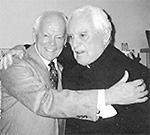
Tim (L) with the late Father Theodore M. Hesburgh, former president of Notre Dame University and his longtime friend and mentor
Tim Carroll has had a long history of service. Following his Peace Corps tour in Nigeria, he created and directed for a decade Eye Care, Inc., in Haiti. For this, he received in 1986 the first Shriver Award for Humanitarian Service. He then took over the new RPCV group as it director before becoming a Peace Corps CD in Pakistan, Poland, and Russia between 1990 and 1995. Leaving the Peace Corps, he founded the Office of Protocol for the Department of Justice, (1997-01) and then retired from government service. In 2001 he sold his home in Washington, D.C., and moved to his family farm located on the shores of Lake Michigan.  He continues his interest in international affairs, however, and travels often and widely. 

Sunday, February 24, 2019

OWL Meeting Focuses on Herbs and Health

I wasn't overly-excited about OWL's topic of "Herbs and Teas as Part of Your Health Program," but now that I've seen Marina's presentation I AM. By "teas" she means infusions, herbs served in drinks we call tea. We all learned a lot about parsley, sage, rosemary, and thyme (I refrained from singing the Simon & Garfunkel song) as well as other herbs like cilantro and parsley. The women in OWL are extraordinarily bright and full of life, so I think it's funny that I have a picture of some herbs against the two flyers "Death and Dying" and "Loneliness & Brain Health."


Here's something new (at least to me) at Yerba Buena Gardens, where our May meeting of the SFVS Book Club took place.  Trying to find ou...