Former CCSF student Sandra Pulido invited Erika Delacorte and me to a series of performances by students in the Spanish MA program at SFSU. She wrote several poems and played the part of Diego Rivera as well as doing a remarkable rap. One of her professors (and now our friend) Ana Luengo gave a presentation on Spain-bound refugees who don't make it there.
Saturday, April 7, 2018
Tuesday, March 27, 2018
Diego Rivera Mural Item in Leah Garchik's Column
Here's the e-message I sent to Leah Garchik in response to this item.
Dear Leah,
I was startled by the item about "Mrs. Diego Rivera" in today's paper. Your contact person is right that the outline identifies Frida Kahlo as "Mrs. Diego Rivera," but they divorced in 1939 and didn't remarry until December 8, 1940, on Diego Rivera's birthday--in SF City Hall, no less! He had finished the mural by November 1940, so she was not yet "Mrs. Diego Rivera. Life published the article on March 3, 1941. Was it Life Magazine editors who chose her husband's identity as hers?
This may be something I should know--or remember. I was the Director the Grant for Instructional Improvement using Rivera's Mural of Pan American Unity at CCSF way back around 2001 or so. We did a lot of lessons around it.
Anyway, if Phelan Avenue is name-changed to Frida Kahlo Way, "Mrs. Diego Rivera" will be identified by her own name!
Tina
Monday, March 26, 2018
Moms Up Front
I went to the first San Francisco house meeting for Moms Up Front, on Sunday, March 25.
Moms Up Front is an environmental movement in which mothers take the lead. All of the women there were concerned with social justice and made the point that we have to have a planet, or what good will social justice do? There were three generations of women at that meeting.
The trained leader of the group was Linda Hutchins Knowles, who was hosted in the home of Maia, the daughter of Kathi Piaggli.
There were three generations of women.
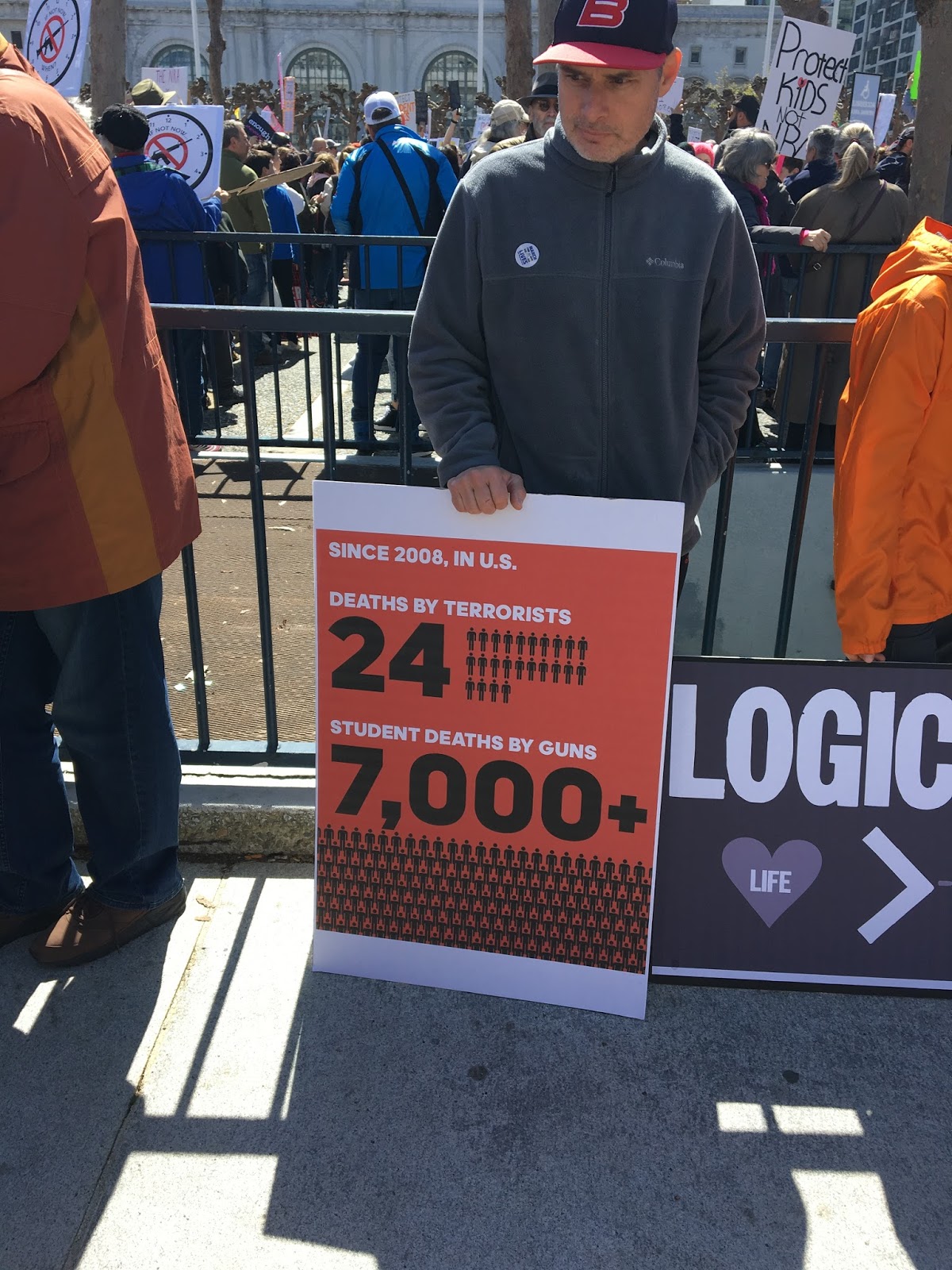
The March for Our Lives in San Francisco
After the March for Our Lives, Annie wrote from France.
Yesterday the demonstrations against arms in the US were a big success! I didn't see images of the marches but I heard that there were at least 800 000 people protesting in the streets! I guess you were among them on Market Street (or another place) Tina and Nicole, and we all hope that something will be done in order to avoid some new school shootings again (but of course with a president supported by the NRA, it's just a feeble hope alas!)
I responded:
Yes, wasn't it wonderful to see--and hear! I went directly from a meeting of OWL, where we learned more about and discussed local election issues (June ballot) to the Civic Center, where well-established people like the acting mayor Mark Farrell, Senator Diane Feinstein, and the former acting mayor London Breed spoke and then each introduced a high school student or a person who had been a high school student at the time of a shooting. They all spoke passionately and well. Someone who had been in the Columbine shooting talked about how she spoke out then, and after the Virginia Tech shooting, she made a donation, but after the Sandy Hook shooting realized that she wanted to do more--like being sure she had divested in anything supporting the NRA. She urged us to do that.
It was Jonathan's birthday, so on the other side of my sign, I had one for him. Also, the woman who conceived of the pussy cat hats for the Women's March promoted the idea of the evil eye--both to ward off evil and to keep a close eye on our politicians!
Some really old slogans were recycled: It used to be "Hey, hey, LBJ, how many kids did you kill today" in reference to President Johnson and Vietnam. Yesterday it was "Hey, Hey, NRA. How many kids have you killed today."
Another recycled one was "Arms are for hugging."
Thursday, March 22, 2018
Shopping with a Beggar on West Portal
Yesterday I had an interesting experience with a woman who begs on West Portal near the post office, where I was mailing saga-type letters to a couple of friends.
She said she was hungry, and since the Manor, the cafe on that block, was closed, I told her I could get her something at Walgreen's, where they have sandwiches and fruit.
So she folded up her chair and came with me.
She told me again that she has 14 children, and only one lives in SF. The others live in Atlanta, and two are in prison--one for life.
She also said she'd rather get bread than a sandwich.
By the time she'd finished shopping, we had a loaf of Hostess Classic Wheat Bread, a package of Oscar Mayer Deli processed turkey (I tried not to cringe), a box of Kellogg Raisin Bran, a gallon of whole milk--all of which we'd agreed on--and then when she thought I wasn't looking , she tossed in a bag of Cheetos Paws. The tab was only $21, 52, which goes to show why poor people eat so much junk food! I bought her two re-usable bags but couldn't figure out how she was going to carry so much. Then she got on her cell phone and placed a call, so I guess someone came to get her and her groceries!
Wednesday, March 14, 2018
Post-Oscar
We had a post-Oscar party with food from the Oscar-nominated movies.
A peach
for Call Me by Your Name
Mushrooms
, toast we can crunch on to annoy whoever is sitting next to us for Phantom
Thread
Keylime
pie for The Shape of Water
Sandwiches
and lemonade for The Post
Eskimo
Pies instead of Dove Bars for I, Tonya
Froot
Loops for Three Billboards Outside Ebbing, Missouri
Wafers
for Lady Bird (but maybe flat Chinese fortune cookies instead
of communion wafers).
Booze and
tea for Churchill
Water
for Dunkirk
Milk (and
still more Froot Loops) for Get Out
Pizza and ice cream
https://www.dropbox.com/sh/p9pa1b9sepqh20b/AAChmlsBIEtADyJ1irYtKsUNa?dl=0
Tuesday, January 30, 2018
"Shocked by the Misery on SF's street, "I struggle to explain it to myself.
It was from one of Heather Knight's always informative and usually compassionate columns that I learned that the disparity between the poor and the rich in San Francisco is similar to Rwanda's. ("Income inequality on par with developing nations," June 25, 2014), so when I read today's column about tourists being "shocked by the misery on San Francisco Streets," I thought, "The tourists?"
I wish the tourist industry that is sturggling to explain the "squalor" to horrified visitors would explain it to me. I don't think, as Handlery says, that our city as failed to address the issue. It addresses it repeatedly, continuously, unsuccessfully.
I've been in love with San Francisco since 1966, when I first moved here, and I don't feel unsafe walking down the streets, but I do feel disheartened. I'm afraid the problem isn't so familiar to us that we "just shrug and keep walking." Nanette Asimov recently reported on the muffin brigade (January 28 "Muffin makers provide a bit of warmth on SF's streets for a day,") and I've tried giving food as well as Hand-Up cards, written about in the SF Chronicle ("Basic hygiene items bring a bit of dignity to life on the streets," May 2, 2017 with Heather Knight's byline)
.
How can anyone think that we're "Totally unfazed by the homeless and mentally ill"? as Kelly Powers says. It's not just the visitors who are dismayed by the misery on SF streets!
Could it have anything to do with HUD's funding being reduced by almost 60 percent between the times that Ronald Reagan and George W. Bush took office?
Other nations have signed international treaties declaring housing to be a basic human right, but the U.S. has never ratified any international treaty guaranteeing its citizens a right to housing, and in most places how is housing regulated? The repeal of the Costa-Hawkins would give cities greater flexibility when setting rent control policies, but this January the repeal effort failed.
While I don't feel unsafe on the streets of San Francisco, I know we have lost the safety net that at one time was provided through social services.
Under Reagan federal spending on subsidized housing went from 20 billion to 8 billion.
In Great Britain the state owns 11 per cent of the public housing, and in France the state owns 16 percent. What percentage does our federal government own?
The U.S. stands with Thailand as one of the only two UN member states whose legislature has not ratified an agreement recognizing the right of everyone to an adequate standard of living.
Even Obama failed to present an action plan and funding for his "Strategic Plan to End Homelessness."
The federal government needs to respond to the homeless crisis with more housing or more funding rather than less.
Our newly-elected mayor-for-six-months Mark Farrell, along with Supervisor Scott Wiener, sponsored the proposition giving police the ability to clear tent encampments within 24 hours. Will he clear them? Where will they go then?
I wish the tourist industry that is sturggling to explain the "squalor" to horrified visitors would explain it to me. I don't think, as Handlery says, that our city as failed to address the issue. It addresses it repeatedly, continuously, unsuccessfully.
I've been in love with San Francisco since 1966, when I first moved here, and I don't feel unsafe walking down the streets, but I do feel disheartened. I'm afraid the problem isn't so familiar to us that we "just shrug and keep walking." Nanette Asimov recently reported on the muffin brigade (January 28 "Muffin makers provide a bit of warmth on SF's streets for a day,") and I've tried giving food as well as Hand-Up cards, written about in the SF Chronicle ("Basic hygiene items bring a bit of dignity to life on the streets," May 2, 2017 with Heather Knight's byline)
.
How can anyone think that we're "Totally unfazed by the homeless and mentally ill"? as Kelly Powers says. It's not just the visitors who are dismayed by the misery on SF streets!
Could it have anything to do with HUD's funding being reduced by almost 60 percent between the times that Ronald Reagan and George W. Bush took office?
Other nations have signed international treaties declaring housing to be a basic human right, but the U.S. has never ratified any international treaty guaranteeing its citizens a right to housing, and in most places how is housing regulated? The repeal of the Costa-Hawkins would give cities greater flexibility when setting rent control policies, but this January the repeal effort failed.
While I don't feel unsafe on the streets of San Francisco, I know we have lost the safety net that at one time was provided through social services.
Under Reagan federal spending on subsidized housing went from 20 billion to 8 billion.
In Great Britain the state owns 11 per cent of the public housing, and in France the state owns 16 percent. What percentage does our federal government own?
The U.S. stands with Thailand as one of the only two UN member states whose legislature has not ratified an agreement recognizing the right of everyone to an adequate standard of living.
Even Obama failed to present an action plan and funding for his "Strategic Plan to End Homelessness."
The federal government needs to respond to the homeless crisis with more housing or more funding rather than less.
Our newly-elected mayor-for-six-months Mark Farrell, along with Supervisor Scott Wiener, sponsored the proposition giving police the ability to clear tent encampments within 24 hours. Will he clear them? Where will they go then?
Subscribe to:
Posts (Atom)
Here's something new (at least to me) at Yerba Buena Gardens, where our May meeting of the SFVS Book Club took place. Trying to find ou...